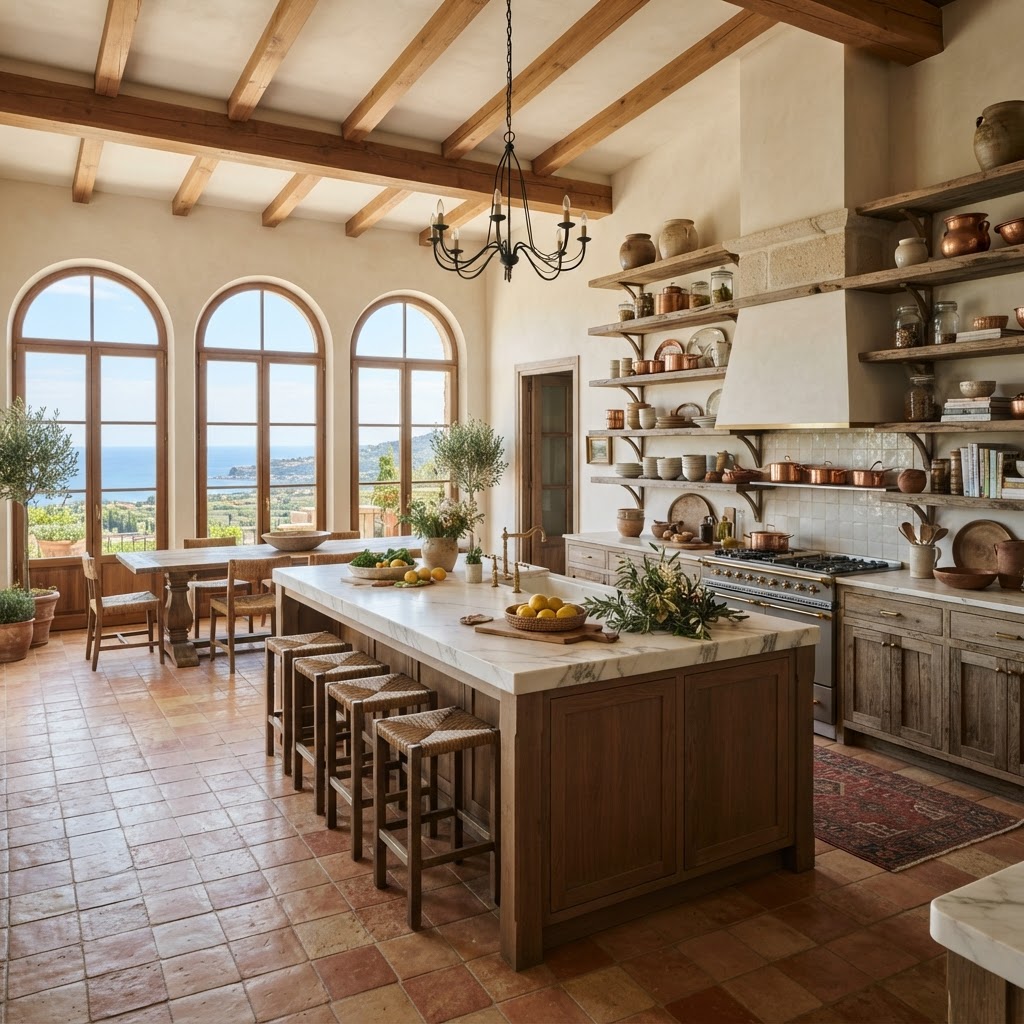
5 Mediterranean Kitchen Designs That Bring The Coast Home
Transform your culinary space with the warmth and elegance of Mediterranean style. These five kitchen designs capture the essence of coastal living through natural textures and earthy palettes.
1. Rustic Terra Cotta Charm
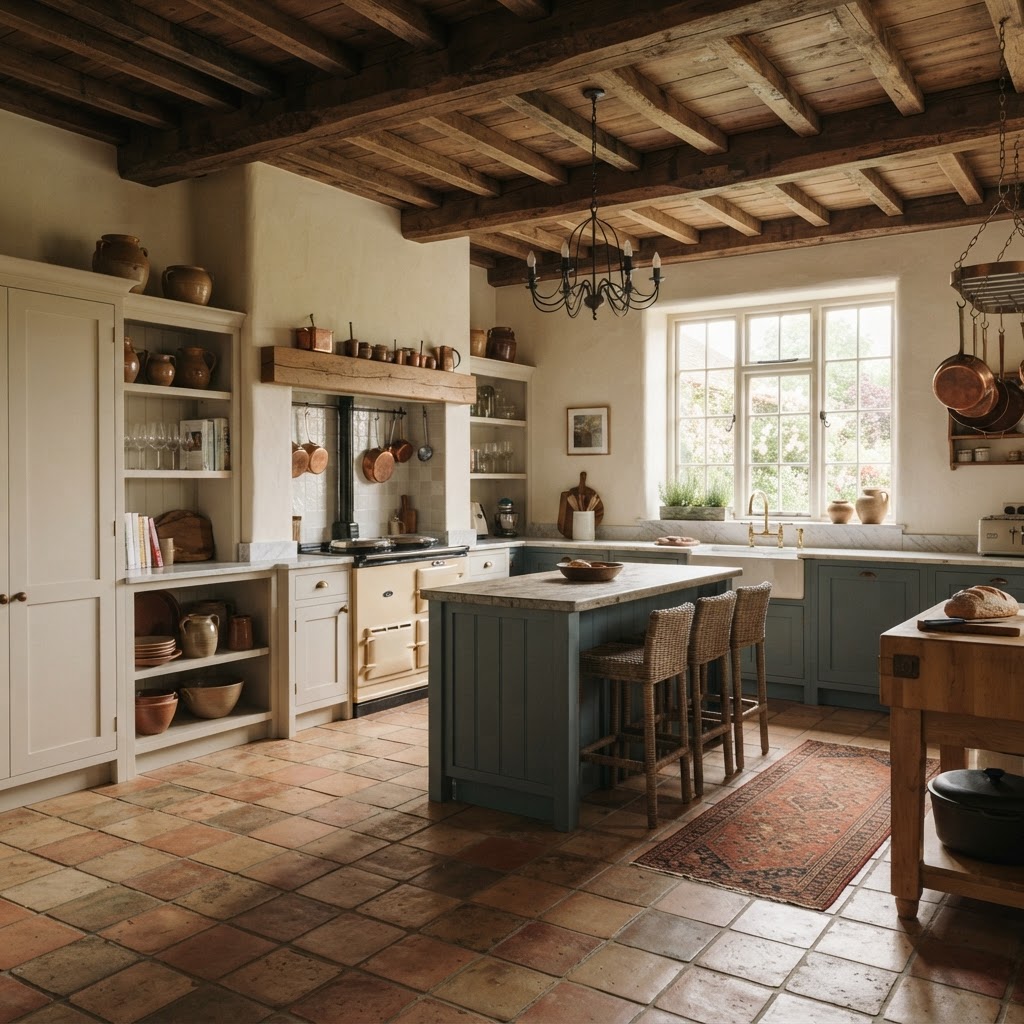
Honestly, if there's one material that instantly transports you to a sun-soaked village in southern Spain or Tuscany, it's terra cotta. There's something about those warm, burnished orange-red tones that just feels ancient and alive at the same time. Terra cotta has been used in Mediterranean kitchens for centuries, and the reason it keeps coming back is simple: it works. It's humble, it's warm, and it ages like an absolute dream.
When we talk about a rustic terra cotta kitchen, we're not just talking about slapping some orange floor tiles down and calling it a day. The magic is in how everything layers together. Think handmade terra cotta floor tiles with their slight irregularities and variation in tone. Think rough-plastered walls in warm white or a faded ochre. Wooden ceiling beams that look like they've been there since 1962. Open shelving made from reclaimed wood, loaded up with ceramic dishes and clay pots. It all comes together to feel completely undesigned, like the space just evolved naturally over time, and that is exactly the vibe you're going for.
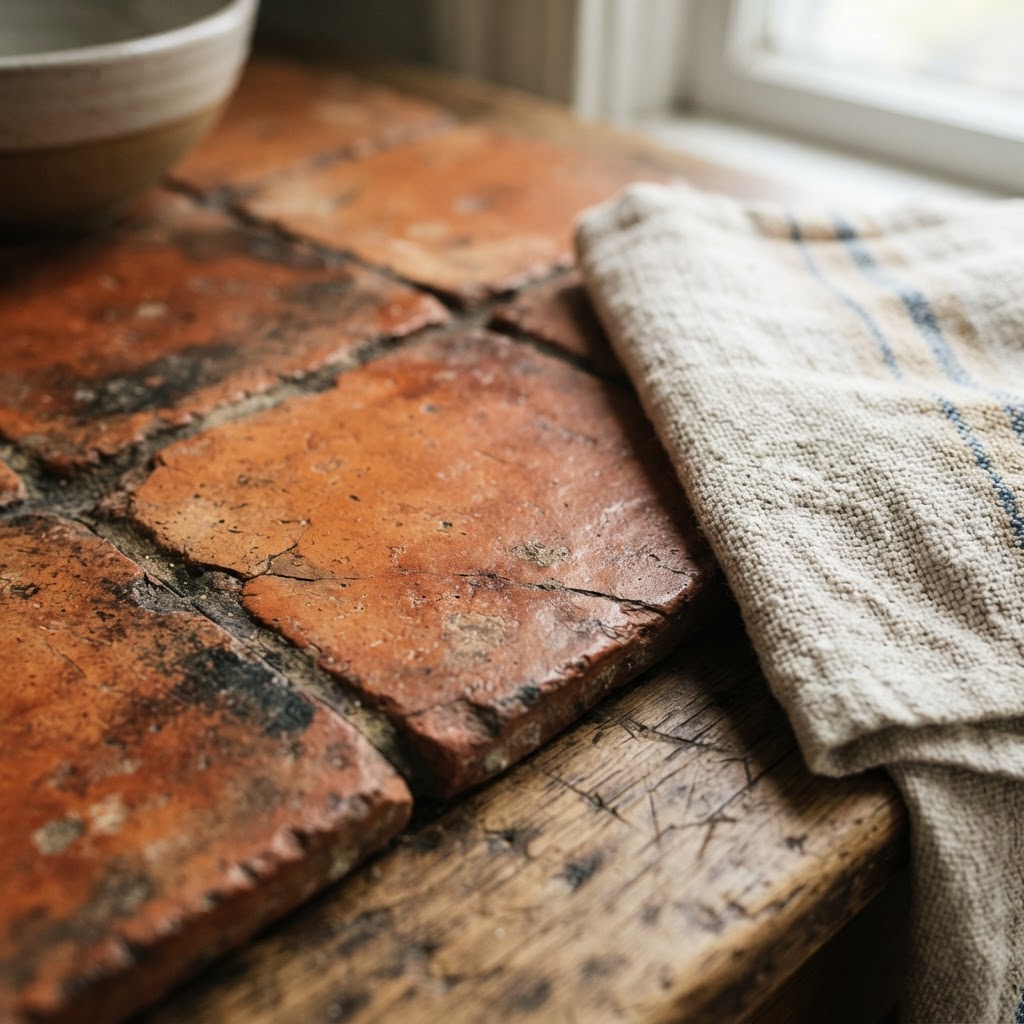
Here's the thing about terra cotta that surprises a lot of people: it's incredibly versatile. You can go full rustic farmhouse with it, or you can pair it with cleaner lines and more modern cabinetry and get this really interesting tension between old and new. Some of my favorite kitchens I've seen recently use flat-front cabinets in a muted sage or forest green alongside terra cotta floors, and the combination is genuinely stunning. The earthiness of the tile grounds the whole space while the cabinetry keeps it feeling fresh.
One practical note: if you're going with traditional unsealed terra cotta, be ready to seal it properly and maintain it. It's porous, so it needs love. But honestly? The patina it develops over time is worth every bit of the effort. It starts to look lived-in in the best possible way. A few key details to pull this look together include wrought iron hardware on cabinets, a farmhouse sink in either ceramic or stone, pendant lights with woven shades or forged metal, and at least one piece of vintage pottery sitting on an open shelf somewhere. These small touches are what make the difference between a kitchen that looks like it's trying to be Mediterranean and one that just genuinely feels like it.
- Flooring: Handmade terra cotta tiles, ideally with slight size and tone variation for an authentic feel
- Walls: Lime wash plaster or warm white paint with visible texture
- Cabinets: Painted wood in earthy tones like sage, terracotta red, or aged white
- Hardware: Wrought iron or hand-forged bronze
- Accessories: Clay pots, ceramic dishes, woven baskets, dried herbs
2. Modern Coastal Minimalism
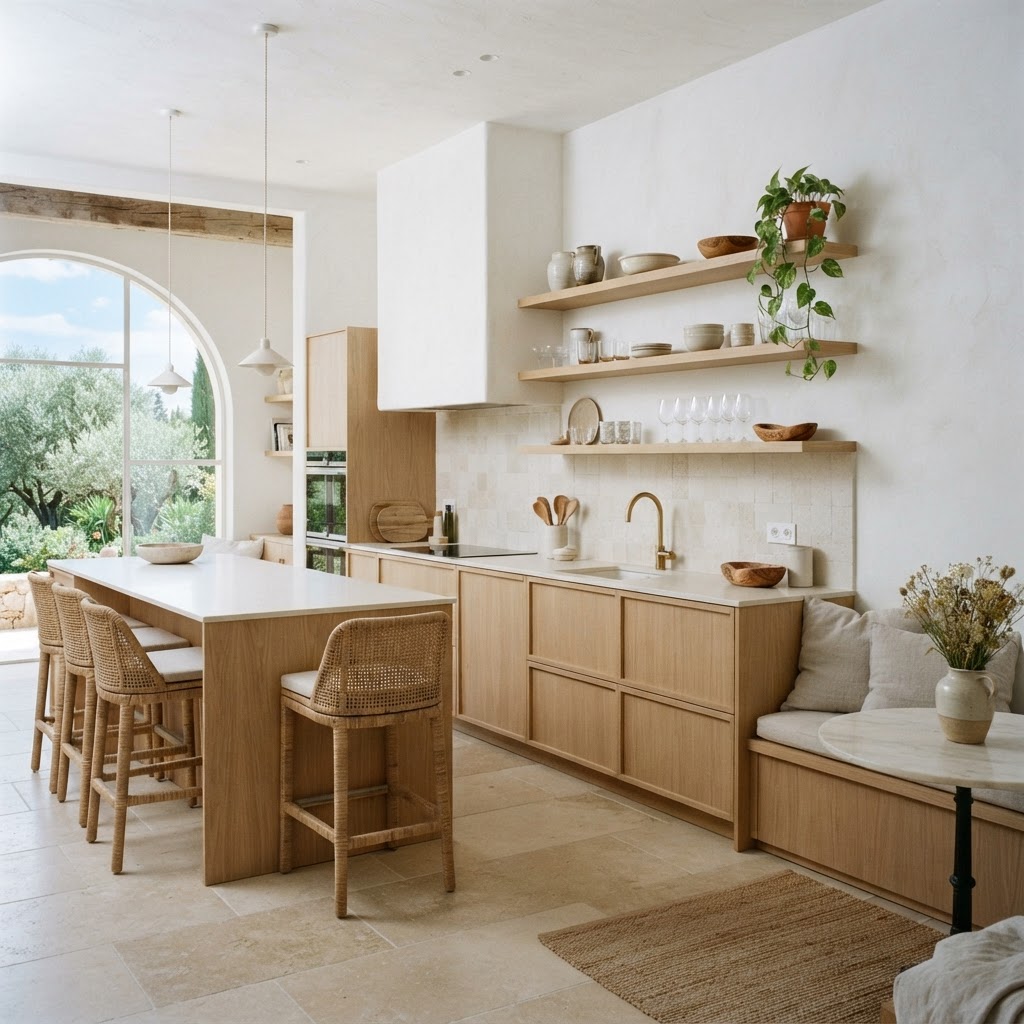
Look, not everyone wants the full rustic taverna situation, and that's completely fine. Modern coastal minimalism is Mediterranean design filtered through a more contemporary lens, and when it's done right, it is breathtaking. Think Greek island homes, the ones you see perched on cliffsides in Santorini, all that brilliant white against a deep blue sky. That aesthetic translates beautifully into a kitchen that feels clean, calm, and endlessly sophisticated.
The palette is everything here. We're talking whites that are almost blue-white, not the warm creamy whites of the rustic style but something cooler and crisper. Pair that with accents in navy, cobalt, or a washed-out cerulean blue, and you've already got the bones of something special. Stone countertops in white marble or a pale grey limestone keep things feeling elevated and natural at the same time. The key with this look is restraint. Every element needs to earn its place.
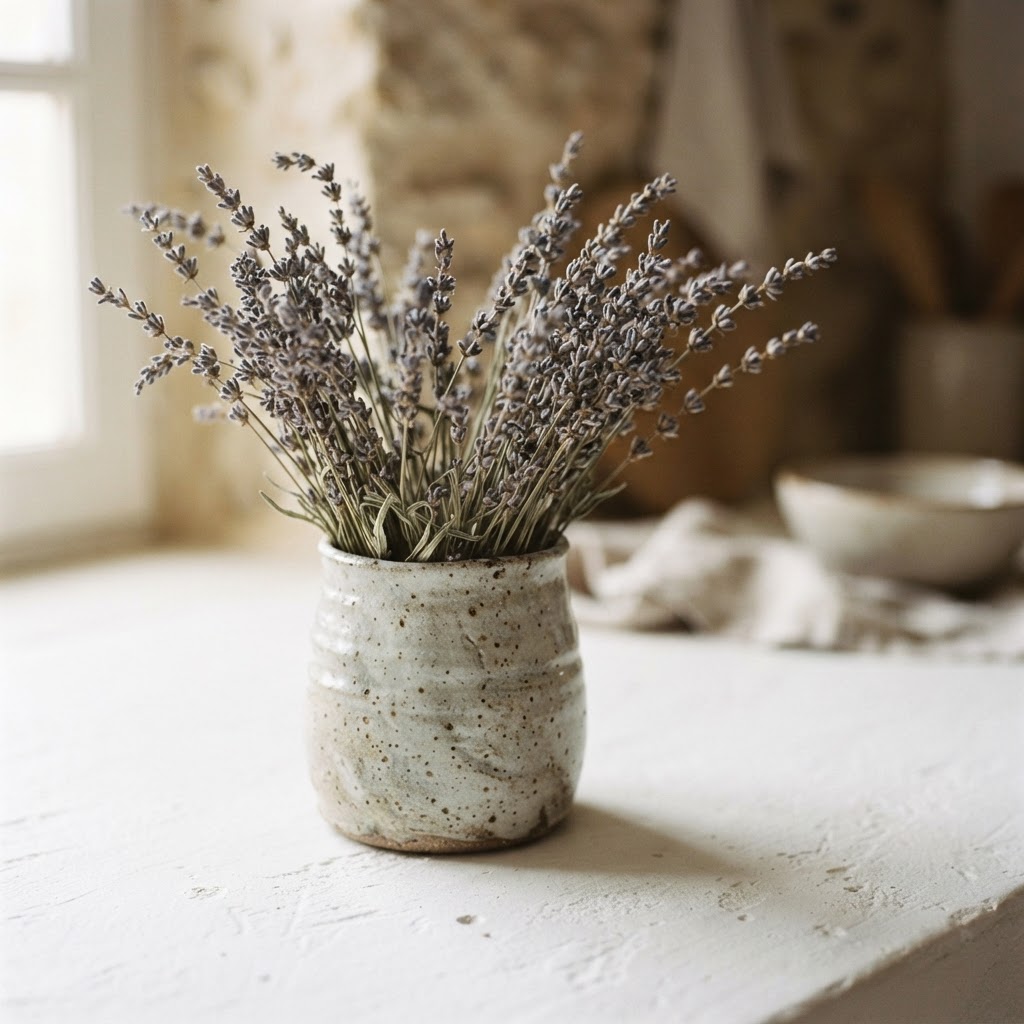
Real talk: the biggest mistake I see people make with this style is overcrowding it. They get excited about the coastal vibe and start adding too many nautical accessories, too many blue accents, too many things on the counter. The whole point of minimalist Mediterranean design is that the space itself should feel like a breath of fresh sea air. Keep the countertops clear. Let the stone speak. Trust the negative space to do some heavy lifting.
Cabinetry in this style tends to be flat-front or with very simple shaker profiles, finished in matte white or a soft greige. Hardware can be brushed nickel, matte black, or even no hardware at all with push-to-open mechanisms for the really committed minimalists. Natural textures come in through materials rather than accessories: a limestone floor, a linen Roman blind on the window, a marble island top with a live edge. These are the details that add warmth without adding visual noise.
"The Mediterranean coast teaches us that beauty doesn't need to be complicated. Sometimes the most powerful design statement is the one that knows when to stop."
3. Patterned Zellige Tile Backsplash
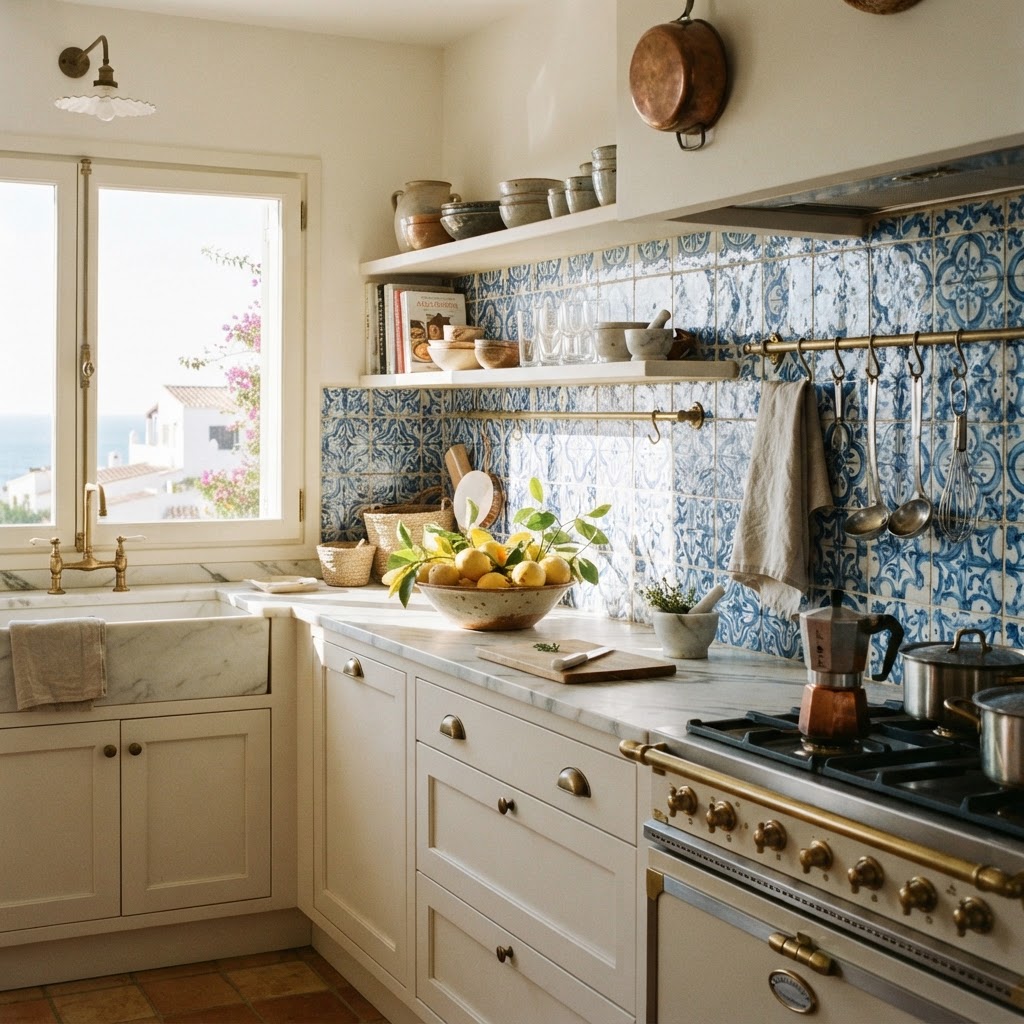
If you want to bring some serious soul into a Mediterranean kitchen, zellige tile is your answer. And honestly, once you go zellige, it's hard to look at regular ceramic tile the same way again. These hand-cut, hand-glazed tiles from Morocco have been decorating kitchens and bathrooms and courtyards for centuries, and there's a very good reason they're having such a massive moment in Western interior design right now. They're just extraordinary.
What makes zellige so special is the variation. Each individual tile is slightly different from its neighbors in color, glaze thickness, and surface texture. When you install them together, you get this shimmering, living quality to the surface that catches light differently throughout the day. A zellige backsplash in the morning light is a completely different experience from that same backsplash at evening with the pendant lights on. It's genuinely mesmerizing.
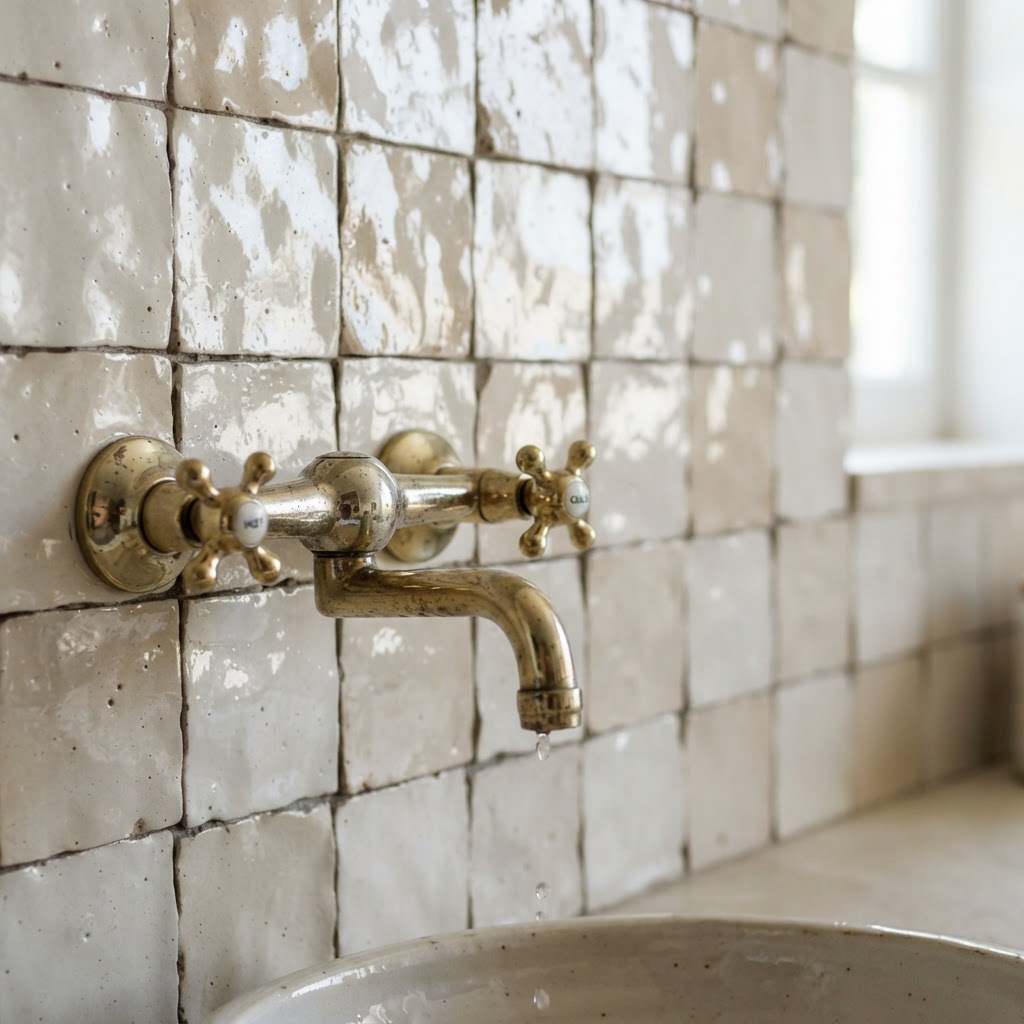
Color choices for zellige backsplashes in a Mediterranean kitchen are genuinely exciting. The traditional options are rich jewel tones, deep teal, cobalt blue, emerald green, and warm terracotta, but there's also a growing trend toward using white or off-white zellige for a more subtle, textural approach. Both work beautifully. The jewel tones give you that full-throated Moroccan opulence, while the neutral tones deliver texture and movement without dominating the room.
Here's the thing about pairing zellige with the rest of your kitchen: because the tile itself is so visually rich, everything else should be relatively calm. Simple cabinetry, clean countertops, understated hardware. Let the tile be the star. If you try to compete with it by adding more pattern elsewhere, you'll end up with a kitchen that feels chaotic rather than curated. One beautifully patterned element per room, and let it breathe. Trust me on this.
- Color options: Cobalt blue, deep teal, white, terracotta, emerald green, or mixed multicolor
- Best paired with: White or neutral cabinetry, warm wood accents, simple stone counters
- Grout choice: Use a matching or tinted grout to let the tile variation be the focus
- Maintenance: Seal regularly as zellige is porous, and avoid harsh chemical cleaners
4. Warm Mediterranean Stone Accents
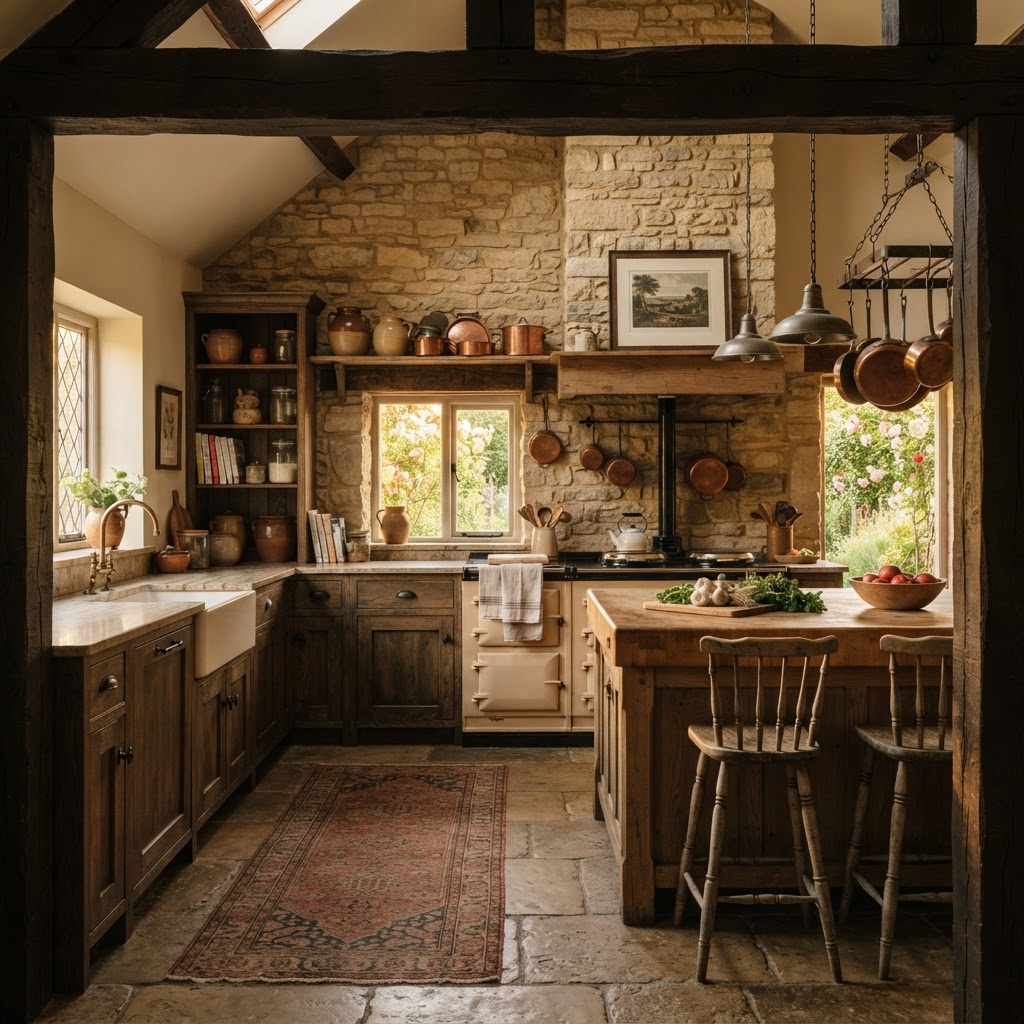
Stone is the backbone of Mediterranean architecture. Walk through any old town in southern France, Greece, or coastal Italy and you're surrounded by it. Limestone walls, travertine floors, carved sandstone archways. The way these materials age and weather over centuries gives them a quality that simply cannot be replicated with manufactured materials. Bringing that stone energy into your kitchen is one of the most impactful things you can do for a genuine Mediterranean feel.
The most dramatic use of stone in a kitchen is usually a statement range hood. A carved limestone or travertine hood over the range, oversized and architecturally significant, becomes the anchor of the entire space. Everything else arranges itself around it. I've seen kitchens where this single element completely transforms what would otherwise be a fairly ordinary room into something that feels genuinely ancient and special. If your budget allows for one splurge in a Mediterranean kitchen redesign, this is where I'd put the money.
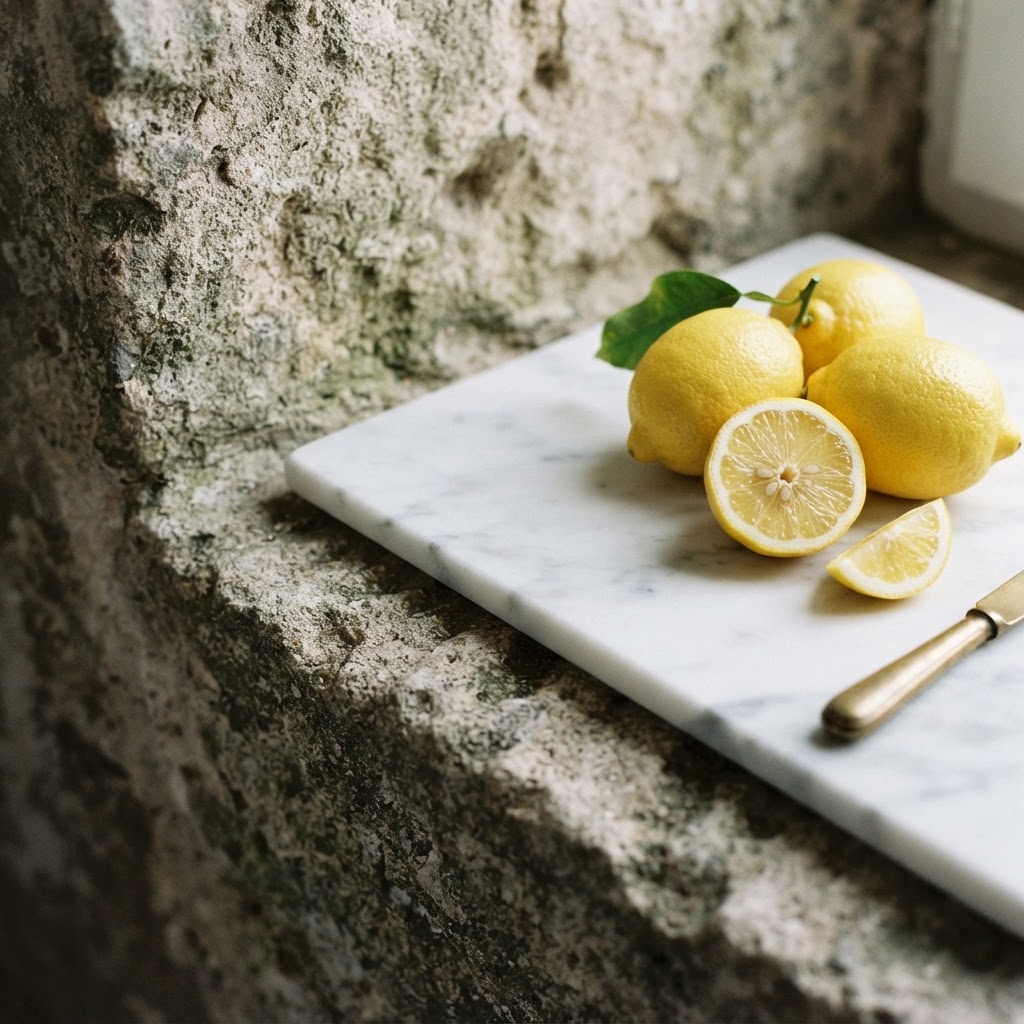
Beyond the range hood, stone shows up beautifully in countertops, particularly in travertine or a warm honey-toned limestone. These materials have a softness to them that marble doesn't, a more matte, almost dusty finish that feels very much at home in a rustic Mediterranean setting. Yes, they require sealing and a bit of care, and yes, they will stain if you're not careful. But the tradeoff in character and beauty is, in my opinion, absolutely worth it. Perfection is overrated. A kitchen that tells a story is infinitely more interesting than one that looks like a showroom.
For those who want stone accents without committing to the full renovation, there are some simpler routes. A stone sink, either a farmhouse-style basin in travertine or a hand-carved limestone trough, is a relatively straightforward addition that has an outsized impact on the feel of the space. Stone trivets, a marble pastry board, or even a collection of natural rock specimens displayed on open shelving all contribute to that earthy, grounded Mediterranean quality. And a stone feature wall, even a partial one behind a kitchen island, can bring serious architectural drama without requiring a full remodel.
The tones you're working with in Mediterranean stone design tend toward the warm end of the spectrum: creamy whites, golden yellows, warm greys, and sandy beiges. These colors absorb and reflect light in a way that makes a kitchen feel perpetually sun-drenched, which is essentially the entire goal of Mediterranean design in a nutshell.
5. Indoor-Outdoor Flow
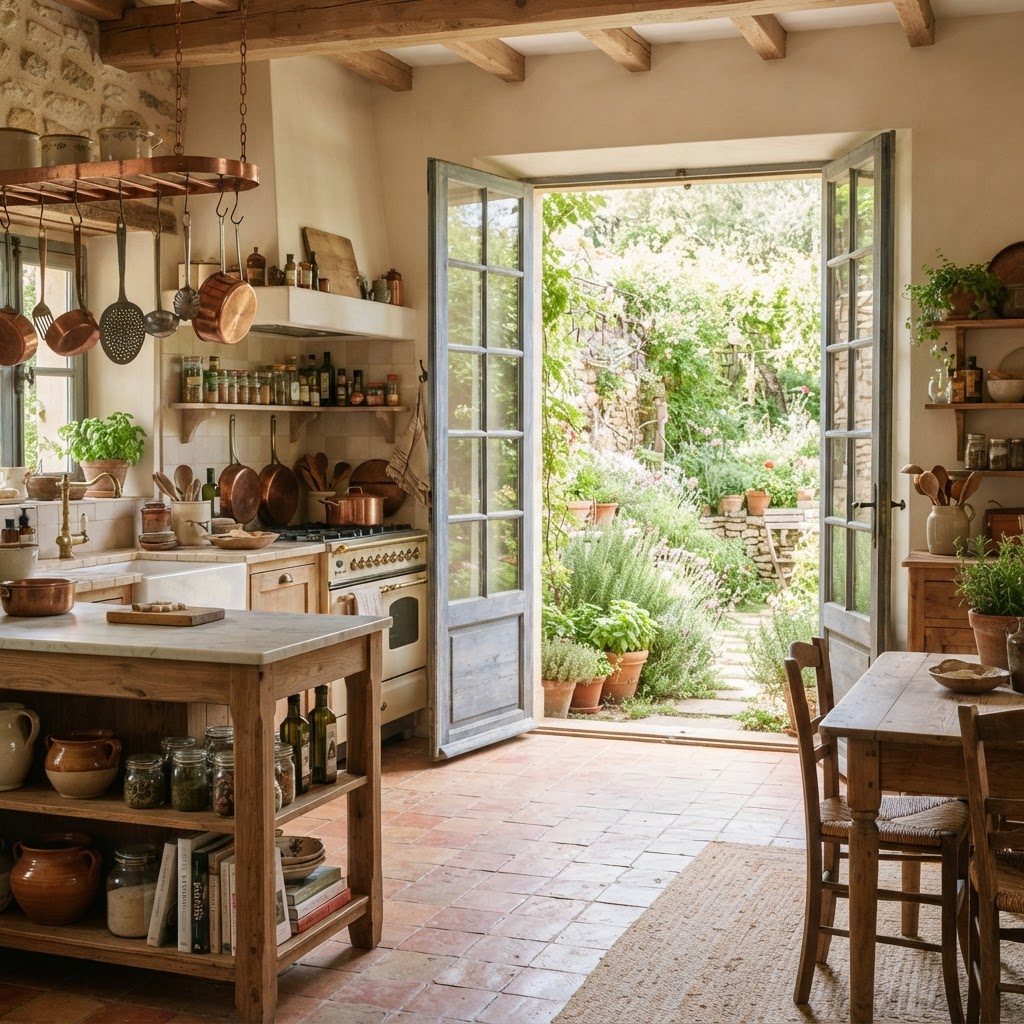
Here's the thing: Mediterranean culture is fundamentally an outdoor culture. Food is grown outside, cooked with the windows open, and often eaten on terraces and in garden courtyards. The kitchen was never meant to be a sealed-off room. It was meant to be a space that breathed with the outside world, connected to the garden, to the herbs growing in pots by the door, to the sound of the sea or the olive trees. This philosophy of indoor-outdoor flow is arguably the most defining characteristic of true Mediterranean living, and it's the one that makes the biggest lifestyle difference when you get it right.
In practical terms, indoor-outdoor flow in a kitchen comes down to a few key architectural decisions. The most impactful is large, operable openings between the kitchen and an outdoor space, whether that's a terrace, a garden, a courtyard, or even just a balcony. Bifold or sliding glass doors that can open an entire wall of the kitchen to the outside completely transform how the space feels and functions. Even on a modest scale, a Dutch door or a large casement window that swings open above a kitchen counter to connect with an outdoor herb garden creates that essential connection to the outside.
Flooring continuity is another big one. When you use the same material or very similar materials inside and outside, the transition between the two spaces becomes seamless. This could be large-format limestone tiles that flow from the kitchen floor straight out onto a terrace. It could be a consistent color palette that bridges the two spaces. Whatever the approach, the goal is to make the eye travel outward naturally, so the outdoor space feels like an extension of the kitchen rather than a separate room.
Honestly, the lifestyle shift that comes with a well-executed indoor-outdoor kitchen is hard to overstate. Cooking with the doors thrown open, herbs snipped fresh from pots just outside, the evening air coming in while dinner's on the stove. This is the Mediterranean dream, and it's achievable even if you're working with a modest space. A kitchen that genuinely connects to the outside is one that you will never want to leave.
- Openings: Bifold doors, sliding glass doors, or large casement windows that open fully
- Flooring: Use the same or complementary materials inside and out to create visual continuity
- Lighting: String lights or lanterns on the outdoor terrace extend the kitchen atmosphere outside
- Planting: Herb pots, citrus trees in large urns, or a kitchen garden just outside the door
- Furniture: A small table and chairs just outside the kitchen door invites casual outdoor dining
Final Thoughts
Mediterranean kitchen design is one of those styles that resonates so deeply because it's rooted in something real. It's not a trend invented by a marketing team. It's thousands of years of people figuring out how to live and eat and cook well in beautiful places with beautiful materials, and the results speak for themselves. Whether you go full rustic terra cotta, lean into modern coastal minimalism, splurge on a zellige backsplash, anchor the room with stone, or open the whole space up to the outdoors, you're tapping into that same timeless wisdom.
The common thread across all five of these design directions is an emphasis on natural materials, warmth, and a sense of ease. Mediterranean kitchens never feel uptight or precious. They feel like places where real food gets made and real life happens. And honestly, that's what the best kitchens always feel like, regardless of style. Start with one element that speaks to you, whether it's a tile, a material, or a layout decision, and let the rest of the kitchen grow around it. You don't have to do everything at once. Good design is patient.
If any of these five directions sparked something for you, I'd love to hear which one resonated most. Drop a comment below, and if you end up doing a Mediterranean kitchen renovation of your own, please share the photos. This is genuinely one of my favorite design territories to explore, and there is always more to discover.
More in Interior
Stay Inspired
Subscribe for new essays on architecture, design, and the spaces that shape us.